You put them on every morning expecting them to just work. And most days, they sort of do. You can see. You get through your tasks. Nothing is obviously broken.
But something is off.
Maybe your glasses don’t feel right by the end of the day. Maybe they slip down your nose every time you look down. Maybe your eyes feel tired in a way that doesn’t quite add up. You’ve probably told yourself it’s normal, or that you’ll get used to it eventually.
Here’s the truth. When your glasses don’t feel right, that feeling is data. And it usually means something was missed.
You Are Not Being Picky
Let’s clear this up first, because so many people carry it around like guilt.
Wanting your glasses to feel right is not high maintenance. It’s not being difficult. It’s not expecting too much.
You spent real money on something you wear on your face every waking hour. Expecting it to feel comfortable, perform well, and actually fit your life is the bare minimum, not a luxury request.
Yet so many people have been conditioned to accept “good enough.” They were handed a prescription, pointed toward a wall of frames, and sent on their way. When something felt off later, they were told to give it time.
You gave it time. It still doesn’t feel right. That’s not on you.

Why Your Glasses Don't Feel Right
When your glasses don’t feel right, the cause is rarely just one thing. It’s usually a combination of factors that nobody took the time to evaluate together.
Here are some of the most common culprits:
The frame was never properly fitted to your face, so it slips, pinches, or sits crooked. The prescription was accurate in the exam room but never verified in real world conditions. The lens design doesn’t match how you actually use your eyes throughout the day. The optical center of the lens doesn’t line up with your pupils, forcing your eyes to work harder than they should.
Any one of these can make perfectly good glasses feel wrong. Combine two or three, and you get eyewear that technically works but never feels like it belongs to you.
The Part Nobody Checked
Here’s something most people never realize. The eye exam and the eyewear are two different things, and the handoff between them is where a lot goes wrong.
A prescription is measured in a dim room while you look at a chart. But you don’t live in a dim room staring at a chart. You work at a screen. You drive at night. You read in bright sunlight. You move between environments all day long.
If nobody asked how you actually use your eyes before building your glasses, the prescription may be technically correct and still not work for your real life.
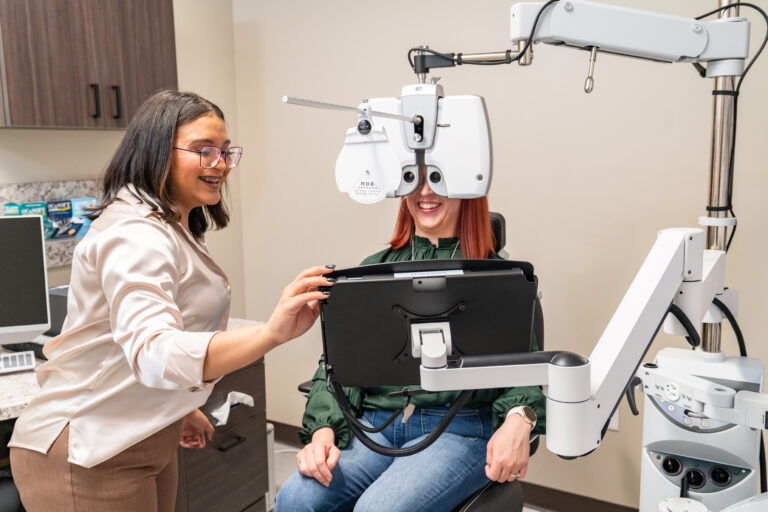
That gap is exactly why glasses can feel off even when the prescription is right. It’s also exactly the kind of thing that gets verified during a proper Eyewear Styling Experience, where the goal is not just filling a prescription but designing eyewear around how you live.
Not sure if this is you? There’s an easy way to find out.
We built a short assessment around the exact things people brush off as normal. The slipping. The straining. The “you’ll get used to it” you never quite got used to. It takes just a few honest answers.
What Actually Fixes It
The fix isn’t simply a new prescription or a different pair of frames. It’s a different process entirely.
When glasses are designed intentionally, everything changes. The fit is dialed in so the frame sits where it should. The prescription is verified in real world conditions, not just on paper. The lens design is built around how you actually use your eyes.
The result is eyewear that feels aligned from the moment you put it on. No adjusting. No compensating. No quietly tolerating something that never felt right.
That’s the difference between glasses that were assigned to you and glasses that were designed for you.
Here's the thing.
You already know something about your glasses doesn’t feel right. You’ve known it for a while. The only question left is what’s actually causing it.
That’s exactly what our “Good Enough” Glasses Assessment is built to uncover. A few quick questions about how your glasses really feel, how you use your eyes, and what you’ve quietly learned to tolerate. No pressure. No commitment. Just clarity about whether your glasses are working as well as they should, or whether you’ve simply gotten used to less.
You don’t have to keep wondering.